The Fable of Dolos
Whither this substack?

In Greek mythology, Dolos (Δολος) is the personification of deception, trickery, duplicity, craftiness, manipulation, and guile. Since there is a lot of that going around today, it seems like a good title for this substack. I also have new book coming in fall 2025 called Age of Deception: Cybersecurity as Secret Statecraft. This book is all about new uses of tech for the old arts of espionage and subversion.
Indeed, the connection between tech and deception is as old as Dolos himself. Aesop tells us that Dolos was apprenticed to none other than Prometheus, the ill-fated Titan who gave fire to humanity (and was subsequently punished by Zeus, who had him chained to a rock so an eagle could peck out his liver for all eternity). The subtitle of Mary Shelly’s Frankenstein—still the best novel about technology ever written—is “The Modern Prometheus.” The historian Thomas Hughes entitled his book on large-scale engineering projects “Rescuing Prometheus.” So mythology gave people fire from the gods, and the rest is just history of technology.
Before going any further, let’s take a closer look at Aesop’s fable on “Prometheus and Truth.” (This is a translation by Laura Gibbs of Fable 530 from Phaedrus, a Roman fabulist who wrote down Aesop’s fables in Latin in the first century AD, whileAesop seems to have been a Greek slave and storyteller who lived in the sixth century BCE). Gibbs translates “Dolus” as “Trickery.” She also translates the Latin “Veritas” as “Truth,” which in Greek is “Alethia” and something to revisit later if I don’t forget. (Ha, see what I did there? “Alethia” literally means “not forgotten.”) Anyway, here is the fable of Truth and Trickery:
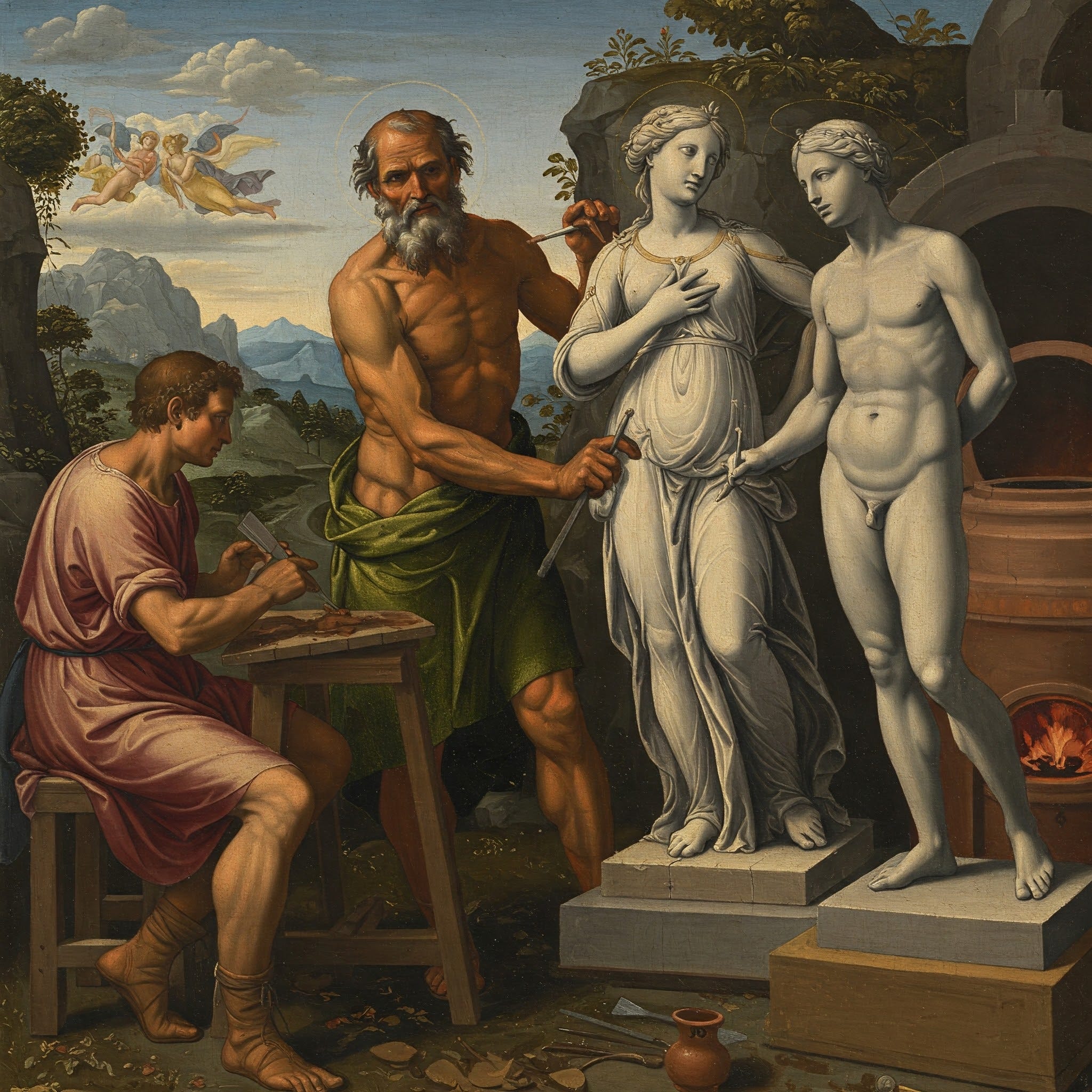
Prometheus, that potter who gave shape to our new generation, decided one day to sculpt a statue of Truth, using all his skill so that she would be able to regulate people's behaviour. As he was working, an unexpected summons from mighty Jupiter called him away. Prometheus left cunning Trickery in charge of his workshop (Trickery had recently become one of the god's apprentices). Fired by ambition, Trickery used the time at his disposal to fashion with his sly fingers a figure of the same size and appearance as Truth with identical features. When he had almost completed the piece, which was truly remarkable, he ran out of clay to use for her feet. The master returned, so Trickery quickly sat down in his seat, quaking with fear. Prometheus was amazed at the similarity of the two statues and wanted it to seem as if all the credit were due to his own skill. Therefore, he put both statues in the kiln and when they had been thoroughly baked, he infused them both with life: sacred Truth walked with measured steps, while her unfinished twin stood stuck in her tracks. That forgery, that product of subterfuge, thus acquired the name of Falsehood, and I readily agree with people who say that she has no feet: every once in a while something that is false can start off successfully, but with time the Truth is sure to prevail.
Isn’t that amazing? The god of technology (Prometheus) is making a representation of Truth in his workshop. Information technology is all about representation. Data is always about something else. That’s why we care about it. Manipulating and computing with representations is way more efficient that manipulating whatever they are about. Promethius in his workshop is an information engineer.
Unfortunately, he recently apprenticed Trickery, who makes a nearly identical version of Truth. The only difference is that this Falsehood has no feet, so it has to follow closely in the footsteps of Truth. So in the very process of making information technology, they introduce the possibility of deception—the subversion of Truth.
This is pretty much the core argument of Age of Deception. The same technologies that improve information and communication also create new opportunities for secrecy and deception. As cyberspace scales up the possibilties for discovering truth and passing it along, deceptive cyber threats exploit these same possibilties. This seems like a disaster, and cybersecurity is definitely a huge problem for governments, industry, and civil society. But the same development also encourages efforts to counter deception, sometimes by even using deception to deceive the deceivers. This means that cyberspace also scales up the risks and challenges of deception. The net result (ha) is that every once in a while something that is false (a cyber intrusion) can start off successfully, but with time the Truth (a cyber attribution) is sure to prevail.
I have a lot more to say about all this, but that’s why this substack is called Dolos.
And here is a bizarre and in many ways perfectly imperfect AI interpretation of the fable of Dolos. Trickery has made sure to include halos and angels along with these two statues of what exactly?